
"Disco Sucks"
An Apology/Apologia

Listen to this essay here, or wherever you get your podcasts.
“Don’t try to take me to a disco
You’ll never even get me out on the floor
In ten minutes I’ll be late for the door
I like that old time rock and roll”
– Bob Seger
This short essay is not actually about Disco. But since we’re on the subject, let’s talk about it a little bit. As most of you are probably aware, and as some of you may even remember, in the late seventies Disco was all the rage. You couldn’t escape it: it was in the clubs, in the supermarket, at the school dance, and, perhaps most importantly, all over the radio, most people’s main source of music at the time. Naturally, this oversaturation ticked some people off. More than anyone, it ticked off racists and homophobes, but it also profoundly ticked off many people, bigoted and non-bigoted alike, who really loved Rock music. Rockers didn’t hate disco simply because they didn’t happen to enjoy it and it happened to be everywhere— they hated it because they saw it as a threat. They were somewhat justified in doing so: radio stations across the country devoted to Rock music were suddenly becoming Disco stations; Pop singers who were Rock-adjacent started incorporating Disco influences instead. There was, therefore, genuine worry that Disco could be the death of Rock.
Now, what’s important to understand here is that for someone whose identity is tied to Rock culture, this sort of threat is not merely an annoyance, but an existential alarm. Silly as that may sound, it’s true: as Ernest Becker trenchantly identified in The Denial of Death, when something we consider a pivotal part of our identity or worldview comes under fire, we are tempted to viciously and viscerally react as if our very lives are being threatened, because, in a sense, they are: we are our identities, and if the system of meaning that we construct for ourselves to stave off the terror of mortality is called into question, it can provoke primal responses which seem irrational and extreme to outsiders. This, Becker argued, was the root cause of all ideological violence throughout the bloody annals of world history.
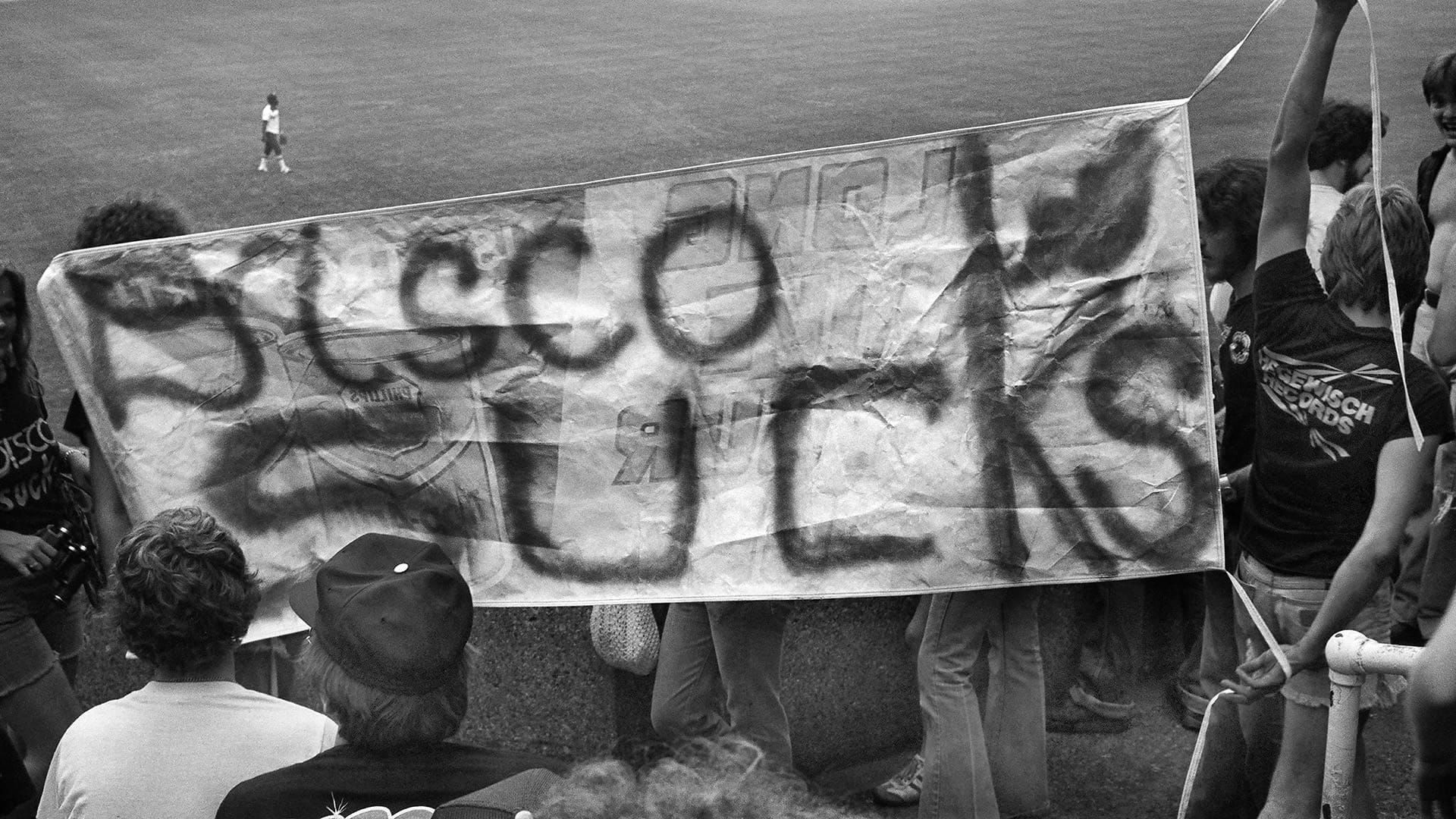
And thus, what became known as the “Disco Sucks” movement. In my own city of Chicago, on Christmas Eve, 1978, a twenty-four year old Rock DJ named Steve Dahl was fired from the radio station WDAI, one of the casualties of the nationwide radio shift from Rock to Disco. Naturally resentful, when he was then hired by rival Rock station WLUP, he knew there were others who felt as he did, and made it his mission to destroy Disco. Whenever he was on the air, he issued a call to arms to everyone who was, quote, “dedicated to the eradication of the dreaded musical disease known as Disco,” and cultivated thousands of gang-like followers in the Chicago area united by the motto: “Disco Sucks,” a sentiment that soon became famous nationwide. Dahl’s followers, known for some arbitrary reason as “cohos,” would show up by the hundreds to support Rock events and harass Disco events. In May of 1979, Bob Seger released his nostalgic anti-Disco anthem, “Old Time Rock ‘n Roll,” which would go on to become one of the biggest hit songs of the 20th century. The backlash had arrived.
The owner of the Chicago White Sox, Bill Veeck, certainly thought so. His people reached out to Dahl, and a promotional event known as “Disco Demolition Night” was soon on the calendar, scheduled to occur at Comiskey Field on the night of a Sox doubleheader against the Tigers. Fans who showed up to the games with a Disco record would be admitted at a discount, and each record would be added to a pile which would then be literally blown up by Dahl as a half-time stunt between the games. Everyone involved worried that they wouldn’t be able to get a big enough crowd.
As it turned out, 50,000 people showed up, 20,000 of whom had to wait outside. There were too many records and too many people, so eventually patrons just took their albums to their seats. As the first game started, Disco records began flying onto the field from all sides like wax frisbees, sometimes striking the players. After the game, true to his word, Dahl detonated a mountain of vinyl on the field to a crowd roaring: “Disco sucks!” The explosion inflamed not only the records, but the masses, and mayhem ensued. Fans rushed on to the field, throwing bottles, burning records, and the White Sox turf was almost completely destroyed. When the story of the riot appeared in national papers the next morning, people around the country took it as an opportunity to vent their own fury about Disco, and soon enough, the genre was finished. By 1980, Disco was effectively dead. Steve Dahl had won.
If you had gone up to Dahl or any of his cohos during this time and said to them: “But surely there must be some Disco records that have value!” they probably would’ve laughed in your face, because you’d be missing the point. “Disco sucks” was never about being fair or objective. It was about survival and conquest.
Already, many of you can probably sense where I’m going with this. Over its three years of existence, I have said many incendiary things on Versecraft. I have proclaimed, infamously, that so-called “free verse” is not poetry. I have, at various times, made Romanticism, Modernism, and Postmodernism my whipping boys. I have condemned confessional poetry and spat upon the avant-garde. I have fired volleys at such illustrious names as T.S. Eliot, Walt Whitman, and even Robert Frost. I have even turned on some of my own formalist brethren, calling on my tribe to be less milquetoast and commonplace. Through all these polemics, I have attracted many people who feel inspired, enthused and vindicated by my words, and for those people I am extraordinarily thankful. Yet I fear that I have also genuinely hurt more people than I previously realized. That is what I would like to address today.
In the past year or so, having left so-called free verse a bloody pulp on the ground, I’ve taken to bashing a certain kind of actual poetry which bothers me. For no particular reason, let’s call it DISCO: Domestic, Ironic, Self-Conscious Opinings. That kind of poetry. On the contrary, I prefer METAL: Monumental, Elijah-Tastic, Archaic Lays. The thing is, I actually have quite a few listeners, and even several close friends, who are not only fans of but who actively write DISCO poetry, and it has come to my attention that some of these people have felt bruised by my words. For the most part, these kind people suffer in silence as I rant, willing to put up with me for some reason or another, and so I have remained blissfully unaware of the wounds I have been causing. One man who valiantly refuses to stay silent however is Matthew Buckley Smith, a phenomenal poet and the host of the SLEERICKETS podcast.
Matthew, whom I consider a dear friend, does not hesitate to tell me when I have offended him. This has happened, to my sorrow, several times recently, as Matthew considers DISCO poetry his own turf, and when I launch barbs against it, he feels the sting. When this happens, I try to explain my position more exactly and articulate the necessary qualifications and concessions, and because we are reasonable and loving comrades, we are always able to swiftly resolve the issue. My dear friend Alice Allan, a terrific poet and podcaster herself, and the sweetest and least combative person in the world, also voices her discomfort with my words from time to time, and at one point even wrote a wonderful, ever-so-mildly retaliatory essay for New Verse Review, “On Fear,” in response to my polemic, “The Iron Lyre.” If sweet, soft-spoken Alice feels driven to such measures, you know the situation is serious.
Perhaps it was a lack of imagination which blinded me to what should have been the obvious inference– that Matthew and Alice were but the tip of the iceberg. As my close friends, they obviously feel comfortable telling me what’s on their mind to a degree that the vast majority of my listeners and readers understandably do not. The fact of the matter is that most of my listeners and readers are not lofty warrior poets, but simply intelligent, thoughtful people who love good poetry and often write it, and who, when they do write it, often write it more in the vein of DISCO than METAL. In a recent talk with Matthew, he informed me, to my horror, that he had received several complaints about me from listeners who have felt disappointed and discouraged by my anti-DISCO sentiments. And so, I would like to take this time to apologize to all of you, and set my views straight once and for all.
When I get on the mic and throw out the semantic equivalent of “Disco Sucks,” there are a couple things I do not mean. I do not mean that people who write DISCO poetry suck and should be ashamed of themselves. I also do not mean that all DISCO poetry sucks without exception. Some of it is actually very good. Therefore, if you happen to write DISCO poetry, please do not ever assume that I am coming for you in particular.
What I really mean when I say “Disco sucks”– and perhaps I should be more clear about this in the future– is that the current situation in literary poetry, in which DISCO seems to be the overwhelming status quo at the expense of the sublime, cerebral poetry I generally prefer– that sucks. To the extent that the prevalence and popularity of DISCO discourages the creation of grand, ambitious poetic projects, that also sucks. Finally, it just sucks to see so many mediocre examples of it everywhere you look. I’m tired of it. I’m tired of turning on the radio and always hearing mechanical, cloying, tinselly Disco, ok? Where’s the Rock, where’s the sick guitar solos? Let’s get some Rock in here, Disco sucks! That’s the sentiment. If all you were hearing on the radio was terrible post-grunge or whatever, you might well say that a spot of Disco would be refreshing. If all you were seeing in the literary journals were boring, blustering, cringy attempts to be the next Homer or Shakespeare, you might well argue that some gently self-mocking reflection on household chores or tableaux of workplace angst or cheerful little ditties about taking a walk in the park could be a healthful change, and I would probably agree.
Now you might say, why are you picking on DISCO when there’s also awful Instapoetry, awful Slam poetry, awful pseudo-Whitmanian propagandistic slop dominating the poetry world? Frankly, my dear listeners and readers, I consider such things beneath my pay grade. Yes, those things also suck. They suck much worse, in fact. But they lie in completely different spheres from the one I operate in: worlds which are governed by different laws and different poetic economies with which I have no commerce. My concern is that the poets who actually read books by dead authors and actually know how to write poems will fall into DISCO unconsciously, carried along by the zeitgeist, assuming that this is how one writes literary-minded poems nowadays, and never considering or daring to explore other horizons.
There is one more important thing I should say about DISCO poetry, because while I have now explained my situational concerns, I still have not properly explained my general distaste for it. “Elijah,” you might say, “just what is so wrong about setting a poem in a household or in the flux of everyday life? Surely there is poetry in the quotidian as much as in anything else.” Well, my friend, you’d be right, but here I’d like to make a crucial distinction between subject matter and what we might call ethos, a distinction I can best illuminate through the double meaning of the word “ordinary.”
In a literal sense, “ordinary,” simply refers to what is normal, standard, or regular. Though it is not usually my preference, I have no inherent opposition to poetry that takes place in an ordinary setting or refers to the workings of an ordinary life. Great literature can come from this. George Eliot, Emily Dickinson, Katherine Mansfield, Virginia Woolf, and Clarice Lispector all found highly individual ways of taking domestic life and elevating it to the plane of the transcendent. In the contemporary poetry of Matthew Buckley Smith, Brian Brodeur, A.E. Stallings, Rhina Espaillat, and Catherine Tufariello, among others, we often find domestic life transfigured into something rich and strange.
My problem, rather, is with ordinariness in the second, pejorative sense: when the use of ordinary subject matter becomes an invitation to ordinary, unimaginative, unambitious, commonplace thoughts, resulting in dull, utterly ordinary poetry. Now of course, mediocre poetry– literally, poetry which finds itself in media ocris, stalled halfway up the mountain of Parnassus– can spring from any subject matter whatsoever. The reason we don’t realize how many bad epic poems have been written is because they have all been rightly forgotten. Nevertheless, my experience tells me that oftentimes poets use ordinary subject matter to excuse or justify ordinary poetry, and this is a problem. No matter what our chosen subject matter, we should all be striving for the extraordinary. Otherwise, what’s the damn point?
When I spoke to Matthew and Alice on SLEERICKETS about “The Iron Lyre,” they made a very good rejoinder to my quasi-absolutism: ideally, they said, poets should not be pressured to write in any way whatsoever– they should feel free to choose the manner and subject matter that best fits their interests and abilities, and that this policy of following of one’s bliss would produce the best poetry overall. One might call this the Adam Smith theory of poetry, the invisible hand of Apollo hovering over all. I actually quite agree with this, and I would say that if you genuinely feel called to primarily write DISCO poems, godspeed. As long as you genuinely attempt to make the poems extraordinary, I will be happy. All I ask is that if, instead, you feel even the slightest urge to write an epic or a tragedy or a Pindaric ode or a mystical psalm, you don’t silence that voice inside yourself simply because such things aren’t usually done. If you want to rock, pick up a guitar and rock. I will salute you.
Did DJ Steve Dahl and his coho hooligans go too far? Probably. Did they miss out on some intriguing musical possibilities that Disco brought to the table because they were so narrow-minded? Definitely. It is never a good thing to let one’s artistic judgment be clouded by spite and spleen. Such rage is what turns one into a mere reactionary. And yet all the same, I sympathize. I sympathize with their frustration at the repetitive mediocrity of what is popular. I sympathize with their anger at their own beloved genre being threatened and replaced. I sympathize with Dahl’s temptation to rouse thousands of disaffected Rock fans to effective action. I even sympathize with the crude slogan “Disco sucks.” It’s simple, effective, to the point. Does it leave nuance at the door and hurt some feelings? Yes, but it also wakes people up in a way that a measured discussion of pros and cons does not, and does justice to the indignation felt. Now, unlike Dahl, I’m not interested in putting my version of DISCO’s head on a bloody pike, nor do I consider it some foul disease that I must cleanse with fire or sneer into submission. All I want is to bring balance to the force, and help give METAL poetry the seat at the table of contemporary letters that it deserves.
Ultimately, my objective on this podcast is neither to be a rabble-rouser nor an aesthetic tyrant, but a trustworthy critical voice in the world of poetry. I have my biases and agendas of course, but I don’t ever want to come off as unfair, flippant, boorishly intolerant, or a bully. I am deeply sorry to all of you who have ever felt devalued or demeaned by something that I’ve said. I promise that mean-spiritedness is never intended. I can be an oblivious fool sometimes, as my friends can attest. In the future, I will try to be more considerate and measured in what I say, and when I criticize, make sure that I am not overlooking the merits of or exceptions to what I am criticizing. If you are a listener to this show or a reader of my essays, I consider you a friend, and I always want to treat my friends decently, even when we disagree. However, because I know that I’m not perfect, I urge you: if you ever get offended by something I say, please don’t let it just eat away at you. I would much rather be yelled at than resented, and I welcome the opportunity to clarify my positions. Write to me, for God’s sake, at versecraftpodcast@gmail.com.
And now that I’ve said all that, let me end on a very important note. You may expect me to be considerate, but you cannot expect me to change. On this show, I prioritize honesty, and I will always fight for what I believe in. I will always fight for the continued existence of the sort of poetry that soothes my soul. I will continue to reminisce about the days of old. I can’t help it– I love that old time Rock ‘n Roll.
I enjoyed meeting both you and Christopher Childers last year at Frost Farm. I am the person who asked both of you if you knew anything about Neanthus. I came across the name like 54 years ago in a book regarding the Neo-Platonist Thomas Taylor. I think it was a Bollingen imprint. Neanthus, at least for me, morphed into a poet who wrote incredibly terrible poems that somehow remained barely interesting and/or provocative. It is like the challenge of trying to portray a boring character accurately in prose without losing interest in the reader. That project continues in brief spurts here and there over decades. The relevance in responding to your essay is that the pursuit of creative expression can take on many different motivations and in my opinion none of them are incorrect or unworthy. I do agree, though, that attempts at expressive art can be mediocre and crap and I do feel that poetry is particularly subject to this problem as all ones needs is a mouth and half a brain to pretend to be a poet. Which is one reason that I avoid talking with some people, that I may have to say what I think.
I am particularly reminded of an interaction I had in the early 1970s with Richard Kostelanetz, editor of Assembling. I had inherited a small-press publication, and I asked him for a contribution. He agreed that I could publish an X. I made a woodblock of an X to print one page of the mag. Then it occurred to me that I was the one making the X and WTF was I doing pretending that Richard Kostelanetz was the creator of the X. That ended off in a bit of a rough correspondence and I presume that he concluded that I was youthfully deranged. You may want to look at his work as visuals at the time were a thing.
I have a friend who hates all music after Mozart, whereas I’ve been delighted by Captain Beefheart, Karlheinz Stockhausen, Dongjing and Bach. Though I really do not like DISCO and once threatened to kidnap an illegal neighbor, blindfold them, throw them into my station wagon and while driving them a hundred miles to nowhere blasting DISCO the entire way. Then leaving them off naked like in a dense woods of the Adirondacks infested with black flies. Fortunately for them they were incarcerated by the legal system.
I have been enjoying listening to Versecraft. I am impressed by the depth of your knowledge and interested that you have explored areas that I have not. Though I do find your diligence in beating your METAL drum, the one that soothes your soul, a bit grating. To note that I am not in the least offended. You may need to try harder. I am not out of sympathy, as when I was younger, I drove people nuts with my passion for the poetic, often to be found evenings standing on street corners babbling all sorts of nonsense. The measure that I advise though is not that you may raise resentment, hurt or pain on the side of those who embrace DISCO, but that you run the risk of moving past an edge of being considered irrelevant to a differing set of a perception of creative aesthetic.
I have felt encouraged by you to allow myself to get a little metal now and then. This has been disturbing and caused growth. While I am comfy in my platforms under the strobe, I haven't been offended by your rants.